


Progressive Web App Development Services

 5,0
5,0
Many organizations invest heavily in attracting website visitors, only to lose engagement after the initial inquiry. A prospect submits a request, leaves the website, and may never return. Follow-up depends entirely on email, phone calls, or advertising remarketing.
A Progressive Web App (PWA) helps bridge that gap by turning your website into an installable application that remains easily accessible on the user's device. With direct communication channels, offline functionality, and a streamlined user experience, organizations can create stronger customer engagement and improve retention over time.
Calculate cost
 One-Click Installation
Users can add the application directly to their device from the browser without downloading it through the App Store or Google Play.
 Offline Functionality
The application remains accessible even with limited connectivity, allowing users to continue interacting with important content and workflows.

 Push Notifications
Send timely updates about orders, deliveries, promotions, appointments, or account activity, encouraging users to return and engage with your platform.
 Integration with Business Systems
Integrate directly with SAP, Salesforce, CRM, ERP, and other business systems. Customer requests, account activity, and operational data can flow automatically between platforms, reducing manual work and improving visibility.
Business Benefits of PWA Development Services
A PWA helps organizations accelerate digital initiatives, simplify platform management, and provide a consistent experience across devices.
- Independence from App Stores
A PWA can be distributed directly through the browser, reducing dependence on App Store and Google Play approval processes while providing greater control over product releases and updates. - Faster Delivery and Lower Complexity
Rather than maintaining separate web, iOS, and Android products, organizations can manage a unified platform that serves users across devices. This reduces operational complexity, streamlines maintenance, and accelerates the rollout of new functionality. - Unified Codebase
A single codebase allows features, improvements, and security updates to be deployed across smartphones, tablets, and desktop devices simultaneously. This simplifies long-term maintenance and helps teams move faster. - Offline Reliability
PWAs can continue functioning even when connectivity is limited. Through Service Workers, important data, forms, catalogs, and user actions can be stored locally and synchronized automatically once the connection is restored. - Integration with Business Systems
A PWA can integrate directly with ERP, CRM, inventory, customer service, and other business platforms. This creates a more connected operational environment while reducing manual processes and duplicate data entry. - Customer Retention and Engagement
Because PWAs launch quickly, install directly from the browser, and support push notifications, they create a convenient user experience that can improve engagement, retention, and repeat interactions over time.

«One of the biggest advantages of a PWA is maintaining a single product instead of three separate ones. Rather than developing and supporting a website, an iOS application, and an Android application independently, organizations can deliver functionality through a unified codebase. New features, improvements, and updates become available to users across devices much faster, reducing maintenance overhead and simplifying long-term product evolution.»
Our Workflow as a Progressive Web App Development Company
A dedicated team works on your project: a Product Manager, developers, UX/UI designers, QA testers and a Tech Lead. We develop using agile Scrum methods and then provide ongoing support for the products under Kanban.
Every project begins with understanding your business objectives, operational workflows, and user behavior. We identify friction points, conversion bottlenecks, and opportunities for improvement, whether that means faster catalog loading, a simplified checkout process, or more efficient internal operations.
The result is a clear implementation roadmap aligned with measurable business goals.
We design both the user experience and the underlying system architecture. This includes customer journeys, application structure, and integrations with ERP, CRM, payment, and internal business systems.
The goal is to create a scalable platform that supports current requirements while remaining flexible for future growth.
Development is delivered through Scrum-based iterations. Working functionality is released throughout the project rather than only at the end, providing visibility into progress and allowing feedback to be incorporated early.
Depending on project scope, this may include customer-facing functionality, account management, offline capabilities, integrations, and administrative tools.
Quality assurance is integrated throughout development. We test application performance, mobile usability, offline behavior, system integrations, and overall reliability under real-world conditions.
Our objective is simple: ensure the platform performs consistently before it reaches production users.
Launch is the beginning of the product lifecycle, not the end. Through structured support and Kanban-based delivery processes, we continue optimizing performance, introducing new functionality, and supporting evolving business requirements.
As your organization grows, the platform evolves alongside it.
PWA-Based Solutions by Our Progressive Web App Agency
A Progressive Web App serves as a unified digital platform that connects customer interactions, partner operations, and internal business processes within a single, consistent environment.
| Solution | Objective | PWA Features | Cost |
|---|---|---|---|
| B2B portal (dashboard) for dealers & partners | Eliminate manual orders via chats, Excel, and calls | Display personal terms, product catalogs, order placement, delivery statuses, document flow, RBAC, ERP/CRM synchronization | Request |
| Employee dashboard with offline access | Ensure work continuity in poor or zero connectivity zones | Offline data processing, creating and saving requests offline, automatic sync upon reconnection | Request |
| Catalog for sales representatives | Quickly show products and close orders on-site | Product search/filtering, live prices, order formation, automated CRM transfer, offline mode | Request |
| Corporate app for employees | Simplify task management and internal communication | Task and request tracking, knowledge base, corporate regulations, notifications, access management | Request |
| Lead generation system (inbound request processing) | Accelerate lead intake and distribution | Request intake, deep CRM integration, auto-routing, instant manager notifications | Request |
| Order processing and control system | Speed up the deal cycle and minimize human error | Order placement, shopping cart, status tracking models, notifications, ERP/CRM integration | Request |
| High-load business platform | Ensure stable performance under extreme traffic spikes | Real-time updates, WebSockets, highly scalable architecture, high-speed interface | Request |
Our Tech Stack as a PWA App Development Company

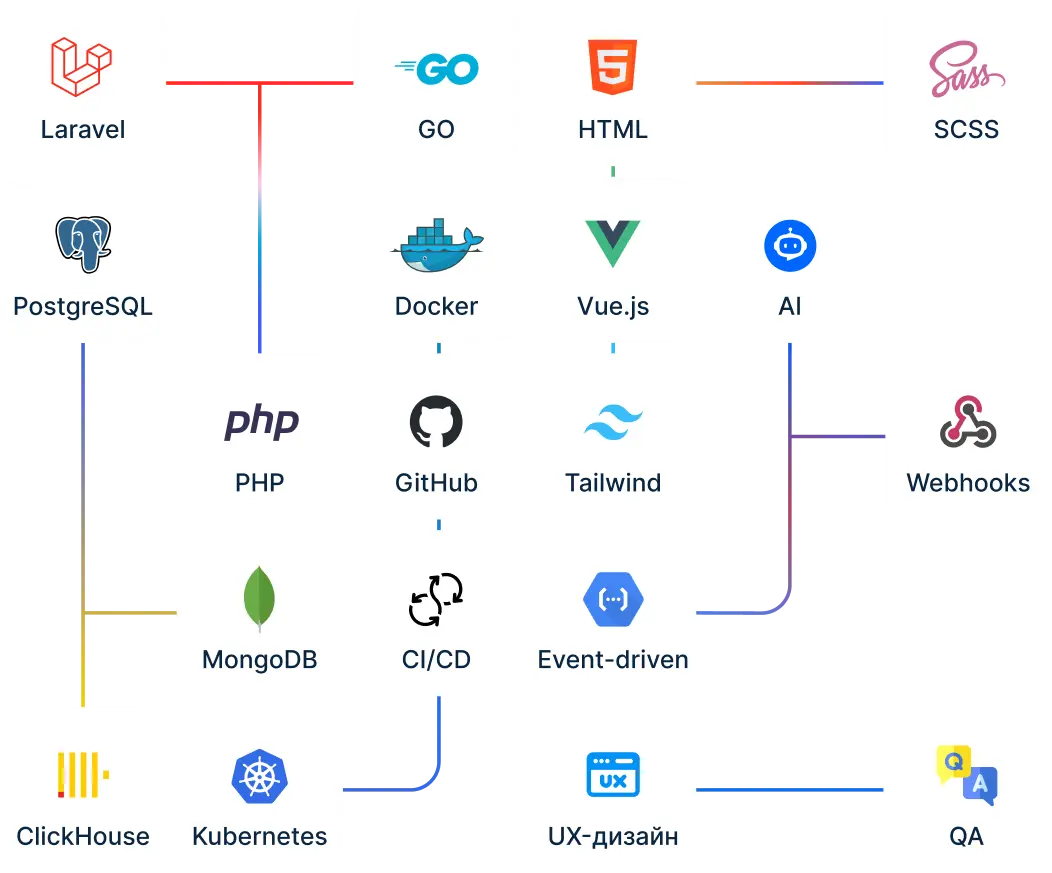
Why Choose Webdelo as Your PWA Development Company
We build Progressive Web Applications designed for long-term business use. All development is performed by our in-house team of 50 specialists, allowing us to take responsibility for every layer of the system—from user experience and application logic to infrastructure, security, and ongoing support. By working with a single technology partner, you avoid vendor fragmentation, communication gaps, and unclear ownership. The result is greater transparency, faster delivery, and a lower total cost of ownership.
Offline Reliability and Data Synchronization
A business application should not stop working when the internet connection does. We implement offline-first architectures using Service Workers, local data storage, and background synchronization to ensure user actions are preserved and delivered once connectivity is restored. Critical business data remains protected, even in unstable network environments.
Scalable Architecture
Our engineers follow established architectural principles, including Clean Architecture, SOLID, and modular design patterns. This creates systems that remain maintainable as requirements evolve and can integrate with ERP, CRM, and other enterprise platforms without requiring costly rewrites.
Quality and Security by Design
Quality assurance and security are integrated throughout the development lifecycle. Automated testing, code reviews, performance validation, and secure development practices help identify issues early, reducing risk while improving reliability and long-term maintainability.
Continuous Delivery and Long-Term Support
Launch is not the end of the project. We implement CI/CD pipelines that allow new features, updates, and fixes to be deployed efficiently with minimal disruption. This enables the platform to evolve continuously while maintaining stability for users and business operations.

«Building a PWA interface is relatively straightforward. The real challenge begins when the application must continue operating reliably in real-world conditions. For example, if an order is placed in a warehouse without internet access, the system must ensure that the data is securely stored, synchronized, and delivered to the ERP once connectivity returns. That requires much more than a front-end application—it requires architecture, synchronization mechanisms, background processing, and operational resilience designed from the start.»
International-Standard Data Security
Privacy by Design

Privacy by Design
Security Governance

Security Governance
Confidentiality by Default

Confidentiality by Default
Our Team
Webdelo's in-house team includes 50 Middle and Senior-level specialists, including software architects, UX designers, developers, DevOps engineers, and QA professionals. Each project is supported by a dedicated cross-functional team with clearly defined responsibilities and transparent processes.
Over 15 years of delivery experience, we have established structured workflows, rigorous documentation standards, and strong knowledge-sharing practices. Technical leads oversee development throughout the project lifecycle, ensuring continuity, maintainability, and long-term stability regardless of personnel changes.






















Industries We Serve
With more than 18 years of experience developing corporate IT systems, we understand the operational realities of dozens of industries. This allows us to align with business objectives quickly, reduce costly rework, accelerate time-to-market, and establish scalable architecture and UX foundations from day one.


FAQ
What is a Progressive Web App (PWA)?
Are PWAs indexed by search engines?
How does a PWA affect SEO and search rankings?
Can you scale the team during development?
Can a PWA be integrated into an existing B2B platform?
Do you work with legacy code?
How do push notifications work in a PWA?
How does a PWA differ from a native mobile app?
A PWA does not require distribution through the App Store or Google Play. Users can install it directly from a browser in seconds.
Key advantages include: Lower development and maintenance costs, Faster deployment cycles, One codebase for web, mobile, and desktop experiences, Automatic updates without requiring user downloads, Immediate accessibility from a website

 Web Development Brief


