Laravel Agency for Custom Web Application Development

120
5,0

We have been designing and building Laravel web application development solutions for medium and large B2B (business-to-business) companies since 2017 in Baden-Württemberg and throughout Germany. With over 30 successful Laravel projects — ranging from corporate platforms and SaaS (Software as a Service) solutions to complex integrations with ERP and CRM systems — we focus on both speed of launch and long-term operational reliability.

Discuss Project
audits 30+ Laravel projects

in active production for clients since 2017

teams 6 In-house Senior+ Laravel developers

no outsourcing to third-party contractors

sem Deep expertise in B2B integrations

payment gateways

team Let’s get acquainted

a brief overview of Webdelo

Services

Our Laravel Development Services

Laravel development services are more than just installing a framework and creating a basic CRUD (Create, Read, Update, Delete) interface. We design and implement web applications where Laravel serves as the foundation for complex business logic, integrations, and a stable operational circuit.

Laravel Service Type What We Do Key Feature Cost
Custom Laravel Development Corporate portals, internal systems, client dashboards, business process management platforms. Architecture designed for longevity — Clean Architecture or DDD (Domain-Driven Design) with clear boundaries between business logic and infrastructure. Request Quote
Laravel Website Development Services (E-commerce) Scalable online stores, marketplaces, B2B platforms with custom price lists, order management systems with payment gateway integration. Support for multi-tenant scenarios and subscription models via Laravel Cashier. Request Quote
Laravel API Development & Integrations We develop REST and GraphQL APIs on Laravel with Sanctum or Passport authentication. We integrate Laravel apps with your ERP, CRM, and Google services. Secure data exchange with rate limiting, idempotency, error control, and webhook retry strategies. Request Quote
Laravel App Development Services (PWA) B2B portals and client tools where a full native app is overkill, but mobile access is critical. Service Workers, offline mode, push notifications, and installation directly from the browser. Request Quote
Legacy Code Migration & Refactoring We transition legacy PHP systems — WordPress with heavy plugins , custom PHP solutions, or outdated Symfony/Yii versions — to modern Laravel. Phased approach without business downtime: "strangler pattern," parallel launching, and gradual stack switching. Request Quote
Performance Audit Systematic analysis of bottlenecks: N+1 queries, suboptimal Eloquent structures, inefficient caching, or missing indices. We implement Laravel Octane (Swoole / RoadRunner / FrankenPHP) for significant performance gains. Request Quote
Code & Security Audit We audit existing projects according to OWASP Top 10, analyze dependencies for vulnerabilities, and evaluate CI/CD processes and test coverage. Comprehensive action plan with priorities and effort estimation. Request Quote
Accessibility (WCAG) Web applications designed according to WCAG 2.1 AA recommendations — contrast, keyboard navigation, semantic markup, and screen reader compatibility. For government or social organizations requiring ` BITV 2.0 compliance. Request Quote
Cases

Our Cases

StockOptikaEN

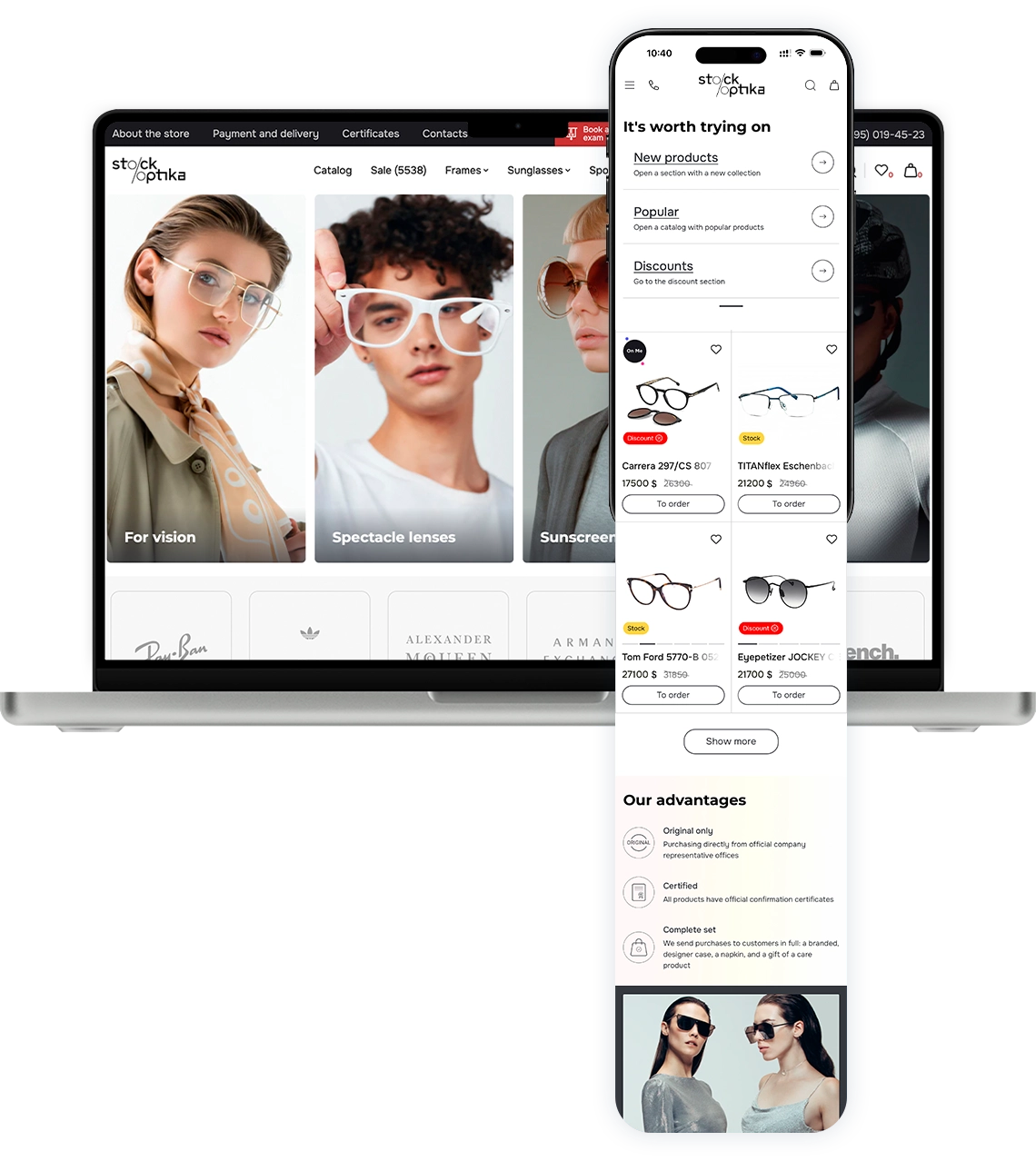
StockOptika - Luxury Eyewear Online Store

As an expert ecommerce website developer, we built an optics store with a complex catalog structure: mobile-first, intuitive filters and search, brand-specific landing pages, and curated collections. Implemented a fast JavaScript frontend with SSR for seamless indexing, WebP image optimization, admin automation, and AI integration for content generation.

20 000

Products

14

Filter Criteria

View Case StockOptika
BiodentEN

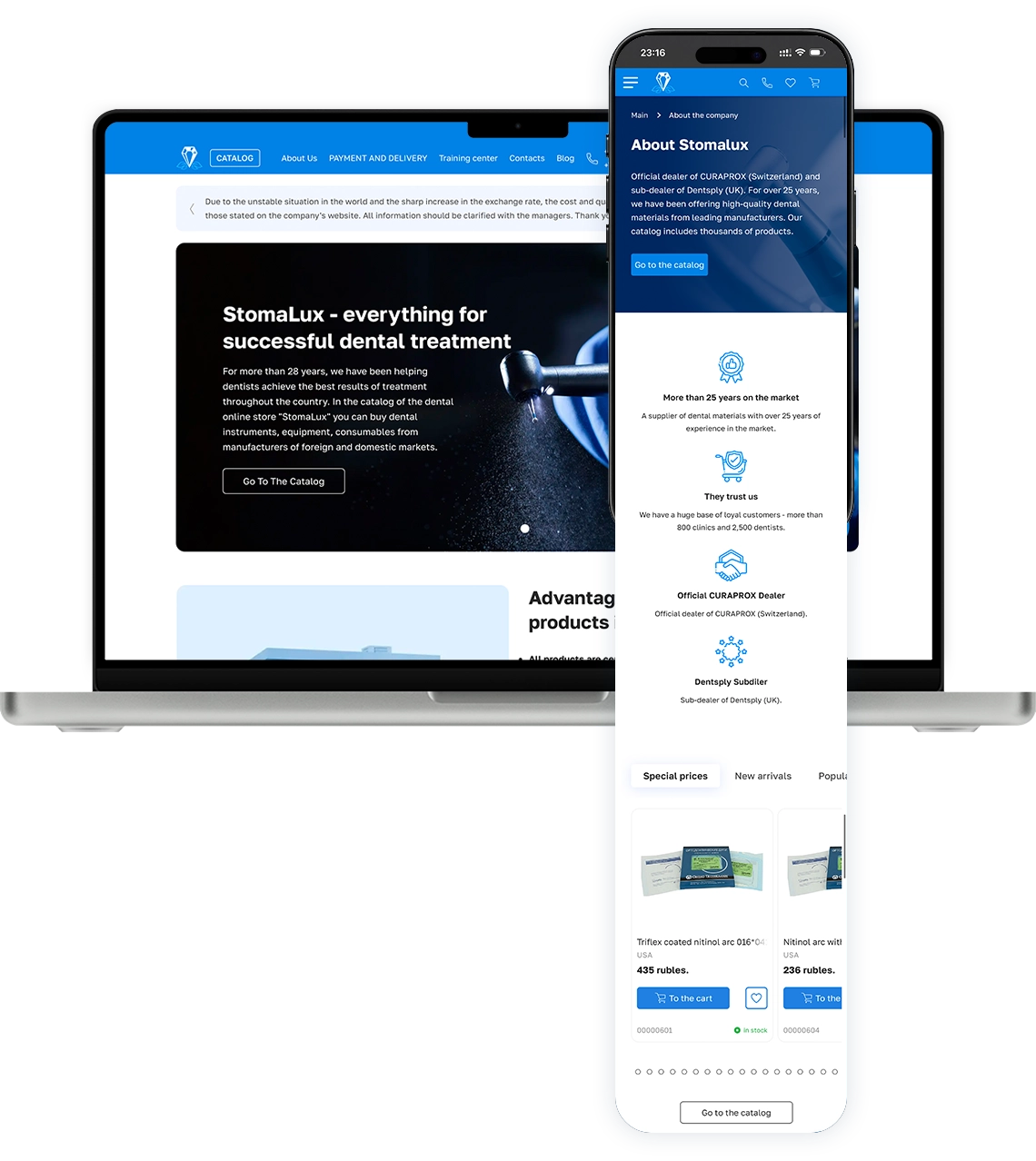
Biodent-Shop

We implemented a scalable platform for "StomaLux." The primary technical challenge was designing a complex catalog architecture for thousands of SKUs. We integrated a high-performance search engine and optimized database queries to ensure a seamless "search-to-checkout" user journey. The backend features a real-time price and stock synchronization system and logistics API integrations. Choosing Laravel allowed us to build a flexible admin panel, ensuring high fault tolerance during peak traffic.

10 000+

products in catalog

< 1 sec

search response time

STACK:
Laravel, MySQL, Redis, Meilisearch
Biodent-Shop
AnsyEN

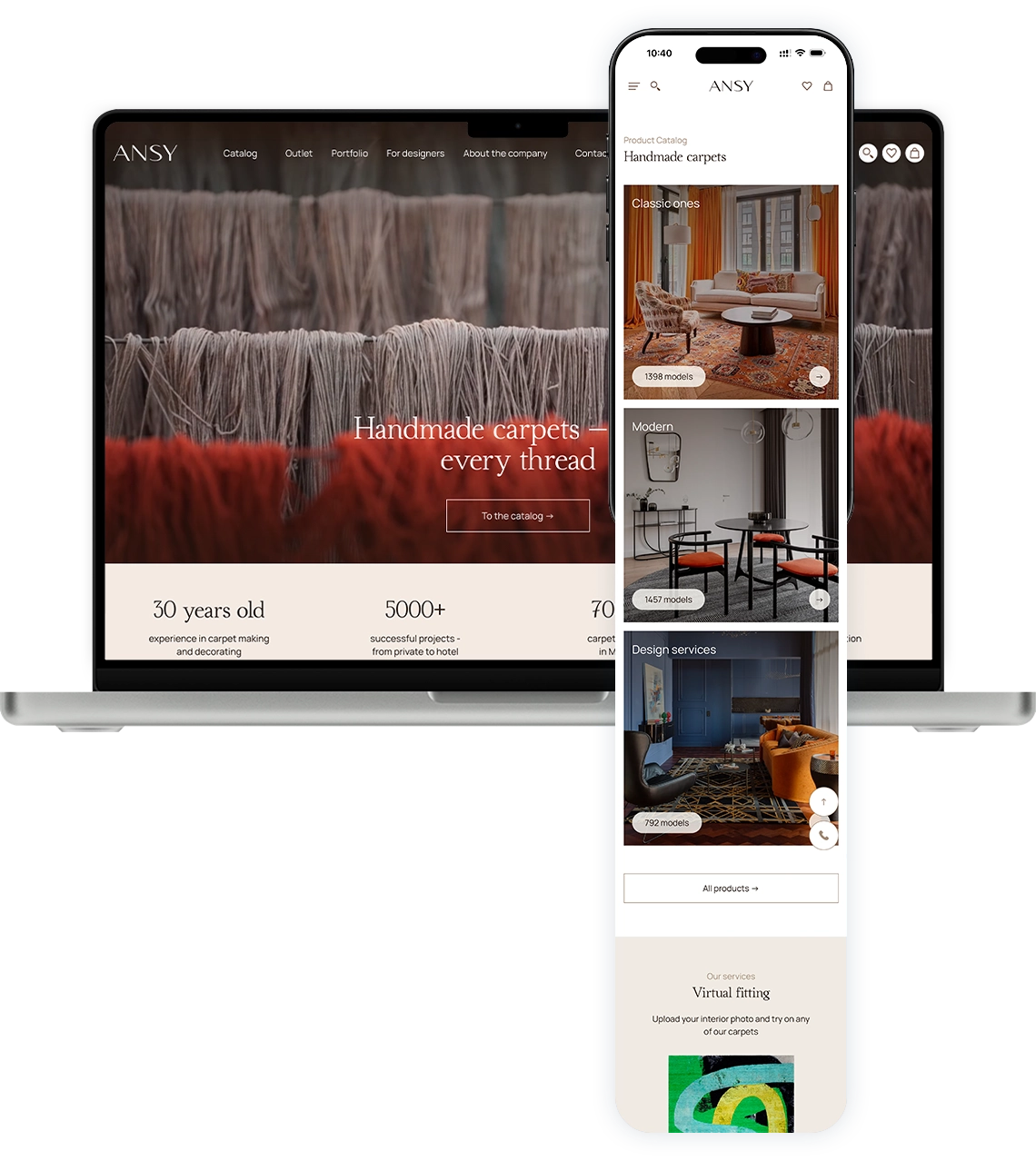
Ansygallery

A high-performance e-commerce project focused on custom logic and architectural flexibility. We developed a complex catalog structure, interactive product cards with "online fitting," and a smart filtering system for the premium segment. Interface responsiveness was achieved through deep backend optimization and Redis caching. We automated inventory management via bulk data imports and background tasks (Laravel Queues). The project is fully optimized for mobile devices and high-level SEO requirements.

faster load times

2 800

unique items

STACK:
Laravel, Vue.js, Redis
Ansygallery

Client Testimonials

We value our clients' trust and openly share their feedback on our workflow, communication, and the quality of our laravel app development services.

November 12, 2024
October 4, 2023
November 12, 2024
Vyacheslav G.
View Full Review
November 17, 2023
Veronika M.
View Full Review
March 14, 2025
February 15, 2025
October 15, 2023
October 9, 2023
November 23, 2023
Valentin Z.
View Full Review
October 15, 2023
January 12, 2024
March 3, 2024
April 16, 2024
Vladislav E.
View Full Review
November 16, 2023
October 15, 2023
October 10, 2023
November 12, 2024
October 9, 2023
December 21, 2023
June 15, 2023
November 6, 2024
November 18, 2024
November 15, 2024
November 14, 2024
April 21, 2024
November 13, 2024
April 21, 2024
November 12, 2024
November 11, 2024
Stanislav G.
View Full Review
October 16, 2024
October 1, 2024
October 8, 2024
September 12, 2024
August 19, 2024
March 8, 2023
Alexander R.
View Full Review
October 4, 2023
July 2, 2024
August 13, 2024
September 10, 2024
November 21, 2024
Anastasia N.
View Full Review
December 3, 2024
January 27, 2025
June 14, 2024
Svetlana A.
View Full Review
May 27, 2024
April 2, 2025
February 17, 2025
October 14, 2024
April 2, 2025
April 9, 2025
April 30, 2025
Alexander F.
View Full Review
May 22, 2025
Vladislav K.
View Full Review
June 12, 2025
June 18, 2025
Nikolay Ts.
View Full Review
May 22, 2026
June 5, 2026
June 17, 2026
Cooperation

Flexible Cooperation Models

We operate under three clearly defined engagement models — we choose the best fit together based on your project profile, deadlines, and the availability of your own team.
Dedicated Team
We assemble a team specifically for your project — developers, an architect, and QA engineers. The team works according to your task list and sprints, integrating into your communication channels (Slack, Teams). Minimum duration — 3 months. Ideal for medium-to-long-term projects with their own roadmap.
Team Augmentation
Targeted reinforcement of your team with Senior Laravel developers or architects — no hiring overhead, no long-term obligations. Onboarding within 5–10 business days with a guarantee of key role replacements. Best for filling specific gaps or needing expert custom Laravel development expertise for a limited period.
Fixed Price Project
Defined scope, fixed cost, and deadlines. Suitable for MVPs (Minimum Viable Product), audits, migrations, or individual modules with a clear technical specification. Before estimation, we conduct a brief and create a requirement document with acceptance criteria to ensure expectations are locked in before the start.
Budget Benchmarks:
  • Laravel MVP — from $27 000, 8–12 weeks
  • Turnkey Development — from $80 000, 3–6 months
  • Senior Laravel Team Augmentation — from $35/hour
  • Performance Audit / Legacy Migration — Quote on request
Final pricing is fixed after the briefing. Project estimation takes 2–3 business days, with a response to your inquiry within 24 hours. We sign an NDA before any detailed technical discussion.
Technologies

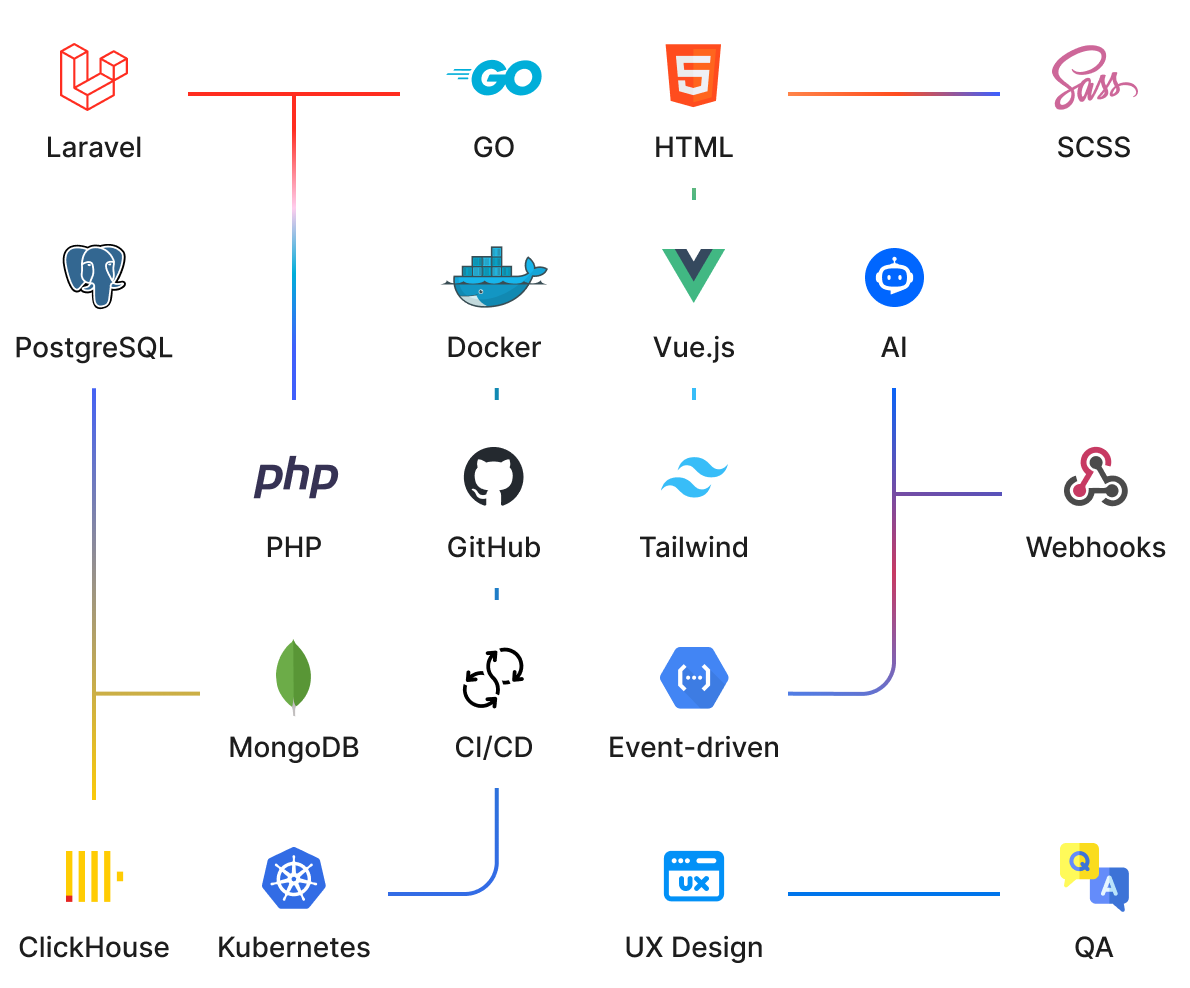
Our Technology Stack — Laravel + Modern Frontend

Laravel backend + Vue/React/Tailwind frontends. Octane, Cloud & Vapor for highload scaling, fast deploys, and headless/mobile/IoT apps.
Framework & Core
Laravel 12+, PHP 8.3+, Composer 2.x.
Database & Search
PostgreSQL, MySQL, Redis, Meilisearch / Typesense for Laravel Scout, Elasticsearch.
Frontend Layer
Inertia.js + Vue 3 (our default for full-stack), Livewire 3, React via Inertia, Tailwind CSS, Vite.
Performance
Laravel Octane for high loads, Horizon for queue management, Pulse for real-time metrics.
Admin Panels & CMS
Filament 3 (primary choice), , Laravel Nova, Orchid, Backpack. We work with any Laravel-CMS, including Statamic.
Queues & Messaging
Redis / RabbitMQ / SQS for Laravel Queue, Kafka for event streaming.
Auth & APIs
Sanctum (SPA and API tokens), Passport (OAuth2), Socialite.
Code Quality
Larastan (max level), Laravel Pint, Rector, Pest for testing, Laravel Dusk for E2E.
DevOps
Docker, Kubernetes, Laravel Forge / Envoyer, Vapor (serverless), GitHub Actions, or GitLab CI.
Observability
Laravel Nightwatch as the primary tool (HTTP tracing, queues, Eloquent events linked to code), Telescope, Sentry for exceptions, Grafana + ELK Stack / Loki, OpenTelemetry.
Cloud Infrastructure
AWS (EC2, RDS, S3, Lambda), .
Stages

Laravel Web Application Development Stages

We operate using the Agile methodology, breaking the project into short, measurable iterations. This allows you to see real progress every two weeks, while enabling us to implement automated quality and security checks (Secure SDLC) at every stage—from initial design to final release.

Stage 1

Consultation & Requirement Analysis

Timeline: 3–7 business days

We start with a brief and an NDA. For migrations, we perform a technical audit of code, architecture, and dependencies. You receive a working document with scope estimation, risks, and launch recommendations.

Stage 2

UX/UI Design & User Path Mapping

Timeline: 10–20 business days

We prototype key screens, agree on user scenarios, and fix edge cases. Figma mockups become the "source of truth" for the frontend.

Stage 3

Agile Sprint Development

Timeline: 6 to 20+ weeks depending on scale

1–2 week sprints. Each begins with planning and ends with a demo. You get access to the task tracker (Jira / Trello) to see progress in real-time.

Stage 4

Testing & Quality Control

Timeline: Performed in parallel + 5–10 days for final acceptance

Unit tests are written alongside code. Feature tests are required before merging. We perform manual and load testing (via k6 or Artillery) before production.

Stage 5

Release & Maintenance

Timeline: 2–4 business days

Deployment via automated pipelines with rollback capabilities. Support is provided under an SLA with P1/P2/P3 priority levels.

Advantages

Our Advantages

By eliminating intermediaries, enforcing mandatory Double Code Reviews, and leveraging our deep B2B integration expertise, we deliver custom laravel development solutions that scale effortlessly and remain stable under high loads.

Laravel Specialization

More than half of Webdelo's projects are on Laravel. We have worked with it continuously since 2017. If PHP hits a performance ceiling, we have a parallel Go team to manage the transition.

In-house Team

6 Senior+ Laravel developers (Seniors, Lead, Architect). No subcontracting. The team that builds your project stays for support.

B2B Integrations Out-of-the-Box

Stripe, PayPal, Shopify, Google Services — we understand the business logic of these systems.

Double Code Review:

Every pull request is verified by two independent senior developers to reduce regression risks and hidden dependencies.

Direct Tech Contact

You communicate directly with the Lead Developer or Architect, eliminating the "broken telephone" effect of going through only managers.

Transparent Pricing

We publish price ranges openly. Estimation after a brief takes 2–3 business days.

framework

Engineering Practices

Clean Architecture & DDD
Domain logic is isolated from the framework using Service, Action, and Repository patterns.
Multi-level Testing
Pest, PHPUnit, and Laravel Dusk for E2E testing of critical user scenarios.
Observability from Day One
Laravel Nightwatch provides a full picture of application behavior in production.
Secure SDLC
SAST analysis, dependency audits, and secrets stored in HashiCorp Vault / AWS Secrets Manager (never in .env).
Projects

Typical Laravel Projects We Implement

While Laravel allows for web solutions of any complexity, we focus on projects with intricate internal logic and deep integration requirements. We specialize in building tools that become the "digital core" of a business. Our expertise ensures reliable and scalable laravel application development within optimal timeframes.

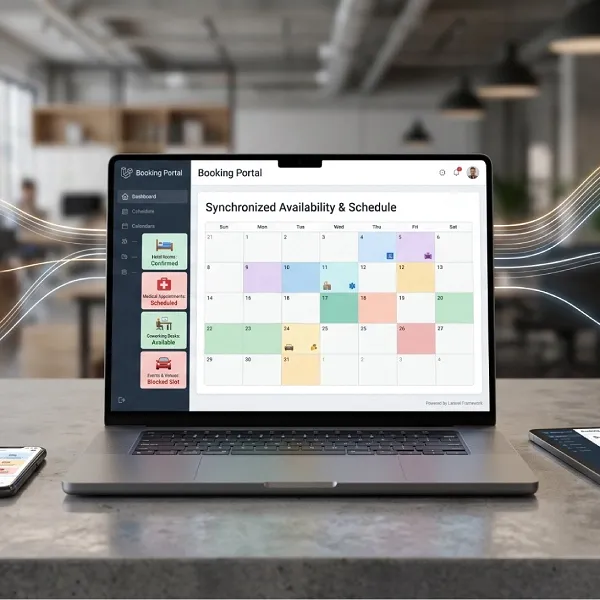
Booking & Reservation Portals

Hotels, co-workings, medical clinics — anywhere synchronization of availability, schedules, and payments is required.
portals

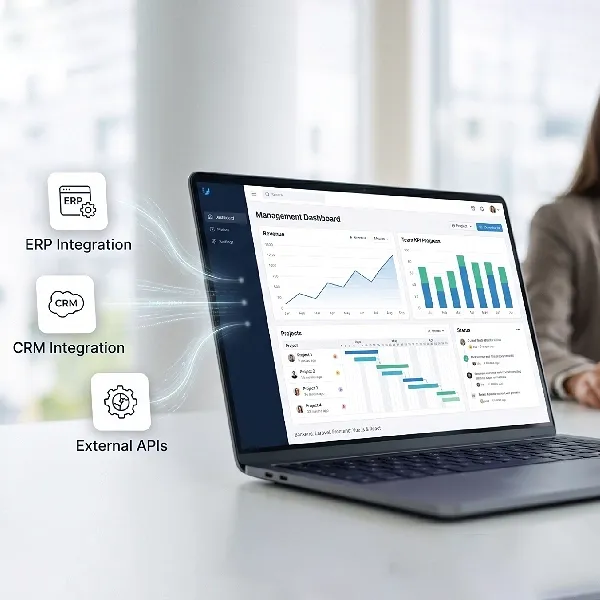
Internal Corporate Portals & Dashboards

Reporting systems, KPI tracking, and real-time visualization integrated with ERP/CRM.
panels

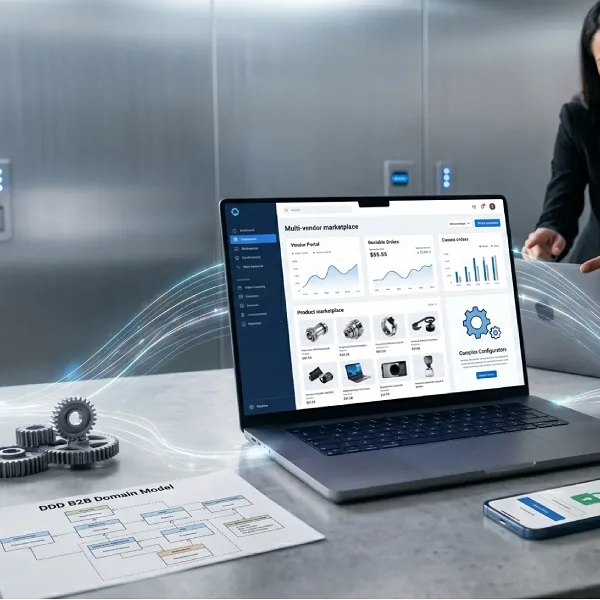
E-commerce & Marketplaces

Scalable custom stores and B2B platforms with complex product configurators and multi-tenancy.
sites

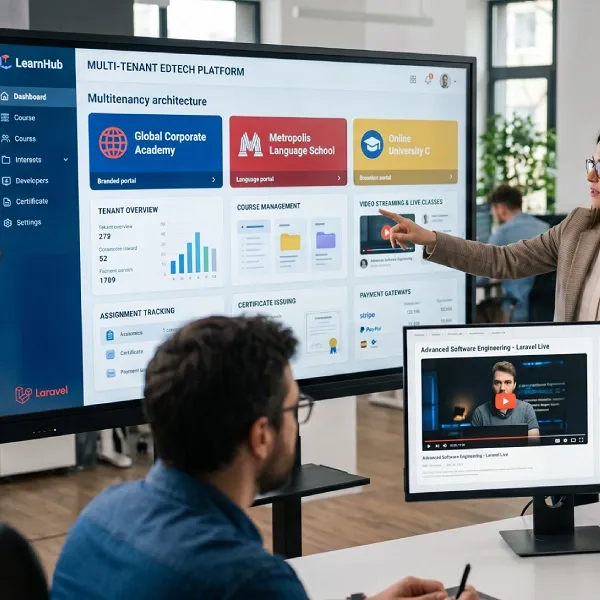
EdTech & LMS

Online schools and course platforms with streaming video, assignment tracking, and automated certification.
educational
portals
panels
sites
educational
Industries

Industries We Work In

We have worked with companies from different industries. Laravel is versatile - but the real value comes when the team already understands the specifics of your business.

недвижимость Real Estate
стоматология Dentistry
Equipment repair
Crypt
Medicine
IT and SaaS projects
салоны красоты Beauty
E-commerce
Construction
Tourism

Questions & Answers

We’ve noticed that business owners often share the same concerns: from data security to team scalability. We’ve compiled honest answers to help you evaluate our approach to architecture before our first call.

Why is Laravel better than a standard CMS?
Laravel is a framework for applications with managed business logic, integrations, and custom processes. A Content Management System (CMS) is suitable for typical content-driven scenarios. When a project involves many non-standard rules, roles, integrations, and scalability requirements, Laravel typically provides much more control over the system.
How secure is Laravel?
Out of the box, Laravel addresses most common vulnerabilities: Cross-Site Request Forgery (CSRF) protection tokens, Cross-Site Scripting (XSS) protection via Blade, prepared statements through Eloquent / Query Builder, and bcrypt/argon support for passwords. However, security is not just about the framework; it is also about processes. We apply static and dynamic security analysis (SAST/DAST), regular composer audit checks, secret management, and security audits before production launch.
Is Laravel suitable for SEO?
Yes. Laravel provides full control over URL structure, meta tags, canonical URLs, sitemap.xml, and robots.txt. For dynamic pages, we provide fast server-side rendering (or SSR via Inertia) so that search engines see the content without needing to execute JavaScript. Issues regarding indexing, loading speed (Google's Core Web Vitals), and semantic markup (Schema.org) are resolved in Laravel just as effectively as in any CMS.
What is the cost of a Laravel project?
Budget benchmarks are published in the "Flexible Cooperation Models" block above. The final price depends on the functional scope, the complexity of integrations, performance requirements, and the Service Level Agreement (SLA). Prior to estimation, we conduct a brief and prepare a requirement document with acceptance criteria to ensure the scope and expectations are fixed. Estimation after the brief takes 2–3 business days.
How do you ensure the security of my data and code?
We sign a Non-Disclosure Agreement (NDA) before the briefing. We use a separate repository on your GitHub/GitLab (or ours, by choice), with access restricted to project developers, secret management, and backups with restoration checks. Secrets never enter the code itself. Upon project handover, you receive full access to all systems and documentation.
Can the team be scaled up or down quickly?
Yes. Our team augmentation model allows you to add a Senior developer to the project within 5–10 business days. Team reduction is handled according to the contract with notification during a standard period (usually 2–4 weeks).
What happens if a new version of Laravel is released?
Updating Laravel is a planned maintenance task. We use Laravel Shift + Rector to automate parts of the changes, followed by manual code review and regression testing. Typically, a major update takes 1–3 weeks for a project of medium complexity.
Contacts

Let's Discuss Your Laravel Project

Send us your brief — we will estimate the project within 2–3 business days. We will sign an NDA before discussing technical details.
TERMINOLOGY

Glossary

A breakdown of terms and abbreviations found on this page. If you encounter an unfamiliar acronym in the text, you will find the full definition here.

*
Agile (Flexible Development) — An approach to software development where work is divided into short iterations (sprints) with regular demonstrations of results to the client and the ability to adjust the plan.
*
API (Application Programming Interface) — A set of rules and connection points through which one program exchanges data with another. For example, a mobile app receives orders from a Laravel application via an API.
*
Architect — A senior engineering role responsible for designing the overall system: choosing technologies, dividing it into layers and services, and handling non-functional requirements (performance, security, scalability).
*
B2B (Business-to-Business) — A business model where the company's clients are other companies rather than end consumers.
*
Backend (Server-side) — The part of the application running on the server: business logic, database, and APIs. We build exactly this server-side part using Laravel.
*
Backlog — A list of tasks and product requirements ordered by priority from which the team takes work for the next sprint.
*
CI/CD (Continuous Integration / Continuous Delivery) — An automated process where every commit to the repository undergoes checks (style, tests, security) and, if successful, is automatically deployed to the target environment.
*
Clean Architecture — A design approach where business logic is isolated from the framework, database, and UI. This simplifies testing and the replacement of technical details without rewriting the core.
*
CMS (Content Management System) — A ready-made platform for managing website text and media content without programming (e.g., WordPress, Statamic, 1C-Bitrix).
*
Compliance — Adherence to regulatory requirements, laws, and industry standards (e.g., GDPR, HIPAA, PCI DSS for payments).
*
CRM (Customer Relationship Management) — Software for managing client records, deals, and communications (e.g., Bitrix24, amoCRM).
*
CRUD (Create, Read, Update, Delete) — The four basic data operations: creation, reading, updating, and deletion. The base functionality of any management interface.
*
CSRF (Cross-Site Request Forgery) — A type of attack where an attacker trick's a user's browser into performing an unwanted action on a trusted site. Laravel prevents this via CSRF tokens out of the box.
*
DAST (Dynamic Application Security Testing) — A security check of a running application by simulating external attacks.
*
DDD (Domain-Driven Design) — A methodology where the architecture and code are built around business concepts and the language of the domain, rather than technical layers.
*
Dedicated Team — A collaboration model where the contractor assembles a separate team specifically for the client's project, working according to their processes and priorities.
*
DevOps — Practices and tools that combine development and operations: deployment automation, monitoring, and infrastructure as code.
*
E-commerce — Selling goods and services over the internet: online stores, marketplaces, B2B platforms.
*
E2E (End-to-End Testing) — Automated testing of an entire user scenario, from an action in the browser to the record in the database.
*
EdTech (Education Technology) — An industry combining online schools, course platforms, and learning management systems.
*
ERP (Enterprise Resource Planning) — A corporate accounting system combining management of production, finance, warehouse, and human resources (e.g., SAP, Oracle).
*
FAQ (Frequently Asked Questions) — A section of a website with typical client questions and answers.
*
FinTech (Financial Technology) — An industry combining payment systems, exchange trading, lending, and other IT-based financial services.
*
Frontend (Client-side) — The part of the application running in the user's browser: interface, visual design, and interaction. Implemented using JavaScript frameworks like Vue, React, etc.
*
Headless — An architecture where the server-side provides data via an API, and there can be multiple client parts (website, mobile app, IoT device).
*
Highload — A system operating mode designed for thousands or more simultaneous users or requests per second.
*
IoT (Internet of Things) — A network of internet-connected devices (sensors, appliances, industrial equipment) exchanging data.
*
KPI (Key Performance Indicator) — A measurable value used to evaluate the achievement of business goals.
*
Laravel Nightwatch — An official observability platform from the Laravel team: it collects and links data regarding incoming HTTP requests, queue jobs, scheduled commands, Eloquent events, and external calls, tying them to code lines and releases.
*
Lead (Lead Developer) — A senior role responsible for technical leadership in the team: task decomposition, code review, and mentoring.
*
No-code — A class of platforms allowing the assembly of websites or apps visually from ready-made blocks without writing code (e.g., Tilda, Bubble). Suitable for landing pages; limited by platform capabilities.
*
Legacy Code — An old part of a codebase written to outdated standards or on outdated technologies that is still in production.
*
LMS (Learning Management System) — A platform for conducting and supporting the educational process: courses, assignments, tests, certificates.
*
MVP (Minimum Viable Product) — The first working version of a product with a minimum set of features sufficient to test a business hypothesis and get user feedback.
*
NDA (Non-Disclosure Agreement) — A legal document obligating parties not to disclose confidential information obtained during collaboration.
*
OAuth — An open standard for authorization where a user grants a site access to their data in another service (e.g., login via Google) without sharing their password.
*
Observability — The ability to understand what is happening inside a running application based on external signals (logs, metrics, traces) to find the causes of problems quickly.
*
OWASP (Open Web Application Security Project) — An international project publishing web application security standards. OWASP Top 10 is a list of the ten most critical vulnerability classes.
*
Pull Request / PR — A procedure for introducing changes into the main code branch: a developer proposes changes, and colleagues review and accept them.
*
PWA (Progressive Web App) — A website that behaves like a mobile app: works offline, sends notifications, and is installed from the home screen without an app store.
*
REST / GraphQL — Two architectural styles for building APIs. REST uses resources and standard HTTP methods; GraphQL allows the client to request only the specific fields needed in a single request.
*
SaaS (Software as a Service) — A software distribution model where the client does not buy or deploy the program locally but uses it via a subscription over the internet.
*
SAST (Static Application Security Testing) — Checking source code for vulnerabilities without executing it.
*
SDLC (Software Development Life Cycle) — The sequence of stages in creating software: analysis, design, development, testing, operation, and maintenance.
*
Senior Developer — A specialist level with independence in technical decision-making and experience in designing complex subsystems.
*
SLA (Service Level Agreement) — A document fixing the contractor's measurable obligations: incident reaction time, availability percentage, and resolution deadlines by priority.
*
SSR (Server-Side Rendering) — A way of building web pages where HTML is formed on the server and delivered to the browser ready-to-use. It improves search engine indexing and initial display speed.
*
Strangler Pattern — A gradual migration strategy where a new system slowly "embraces" an old one, taking over its functionality step-by-step until the old system is fully decommissioned.
*
Team Augmentation — A collaboration model where external specialists join the client's team and work according to their processes.
*
WCAG (Web Content Accessibility Guidelines) — An international standard for web content accessibility for people with disabilities. Level AA is the standard target for compliance.
*
Webhook — A mechanism where one system automatically sends a message to another when an event occurs (e.g., a payment provider notifying your site of a successful payment).
*
XSS (Cross-Site Scripting) — A type of attack where an attacker injects malicious JavaScript into a page, which is then executed for other users. Laravel escapes user input in Blade templates by default.
cookies We use Cookies

We use cookies to improve website performance, personalize content, and analyze traffic. You can choose which categories of cookies to allow. For more information, please see our Cookie Policy. You can change your preferences at any time.

Essential (Required)

Ensure the website functions properly (navigation, access to secure areas). Always enabled and can only be changed in your browser settings.

Analytics

Help us understand how you use the website so we can improve our services. Do not collect personal data. We use several analytics tools for this purpose.

Advertising

Used to deliver personalized ads and measure the effectiveness of advertising campaigns.